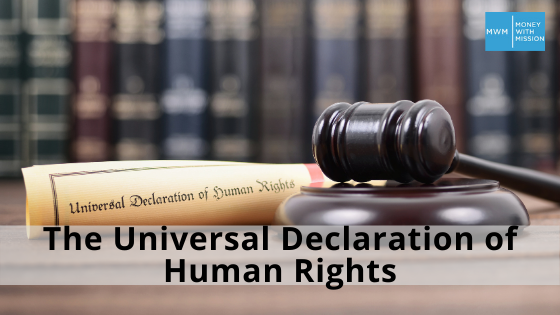
On December 10, 1948, the United Nations accepted the Universal Declaration of Human Rights (UDHR). It set out, for the first time, fundamental human rights to be universally protected. In total, there are 30 rights or articles defined.

Article 17 states:
(1) Everyone has the right to own property alone as well as in association with others.
(2) No one shall be arbitrarily deprived of his property.
Interestingly, the US constitution does not provide for the right to own property; however, once a property is owned, rights are provided to keep it.

How are you working to enjoy this right provided by the United Nations? Many own their own home.
That’s great! You worked hard to have the sense of security that can come with owning your own home.
That sense of security is vital.
I am going to confess something. I do not own the home that I live in. Yes, I can afford to do so. I choose not to. Instead, I own 4 houses that I rent to others to live in. I also am part owner of a resort, an apartment building, and a residential assisted living home.
 Think about it; we have the right to own property. Why not use that right to help those who do not have the ability or desire to own their own? Yes, I am paying rent every month, which to many may seem like a waste, but instead of putting a big chunk of money into my residence, I have used that cash to purchase cash-flowing assets.
Which brings me to a point:
The house that you live in is not an asset.
OK, it might be an asset once you sell it, but then it is not your home anymore. And notice that I said “might” be an asset. If you have to sell at a low point in the market because of some unforeseen circumstance, you make nothing and may actually lose money. The asset is the thing that pays you.
Own your residence, your shelter, if that brings you security. To many, that security is essential. But once you have it, look to put some assets on your balance sheet. Become more secure by increasing your streams of income. Make sure that you exercise your right to own property either alone or with others.
If this strikes a note of truth for you, let’s talk. Complete our brief Building Resilient Wealth questionnaire. It’s important to know where you are starting. After that, let’s schedule a time to talk.
Let me help you make 2021 your year of multiple streams of income.