
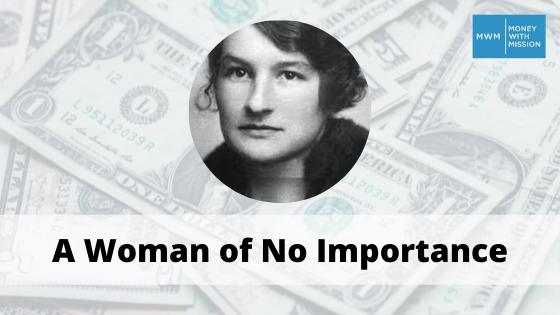
I was recently introduced to Virginia Hall via an email about leadership, and it made me think of so many of the women I have worked with over the years.
I am not usually that interested in history, but a couple of things caught my attention.

This woman is called a hero of WWII, and evidently, even historians don’t know much about her.
According to Sonia Purnell, author of A Woman of No Importance The Untold Story of the American Spy Who Helped Win WW II, it is “Partly because she didn’t like blowing her own trumpet. She didn’t like the whole obsession with medals and decorations; it was about doing your duty, being good at your job, and earning the respect of your colleagues. She didn’t go out of her way to tell people.”
I know that so many of us can relate. We just do our work, not thinking about the ripple effects that we are creating or thinking about how the actions we are taking today will impact our future and the future of our family.
The taxes we pay are one such thing; a payment made nearly every day that most of us do not think about. As a W-2 employee, the government takes their money before you ever get your check, and then the following year, when we do our tax returns, we either get money back or we have to pay a bit more.
Different people have different strategies. I have friends who always want to get money back, so they always have extra taken out of their paychecks throughout the year, thereby living on less.

Others want to see as much in their paycheck as possible throughout the year, having more to live on.
Both of these strategies can be problematic. If you are someone who has more than enough taken out throughout the year so that you can get a big check, you are giving the government an interest-free loan and sacrificing your lifestyle for the government.
For those who choose to have larger checks throughout the year and write a check to the government, you also have to live below your means, it’s just delayed.
There are a lot of ways to mitigate your tax burden. By the way, if you haven’t heard this before,
Taxes are your biggest lifetime expense.
I know that some of you out there think that it is patriotic to pay taxes, that it is your duty as an American citizen to pay your fair share of taxes, and it is; the question is, what is your fair share?

A famous economist John Maynard Keynes said, “The avoidance of taxes is the only intellectual pursuit that carries any reward.”
Ayn Rand talks about paying taxes voluntarily, paying for the services you want and need. She admits that this would be a very complex system. We could all agree that it would be if the government-administered it.
Here is my point: I want my money to go where I want it to go and do what I want. I believe that most of you do too.
If we could keep more of it, what I would have my money do would align more with my values and what is important to my family and me. Are there greedy people who would pay nothing and take all they can in services? Yes, but I believe that they are the minority.
Planning and strategy are necessary to keep more of your tax money to distribute as you see fit. Real estate investing is one way to mitigate your tax burden; investing in real estate with a positive social impact can minimize your tax burden AND have your money working in alignment with your values.
It is an intellectual pursuit worth having.
Let’s strive to leave the legacy that is important to each of us, reach for significance.
Schedule a call to get started.