
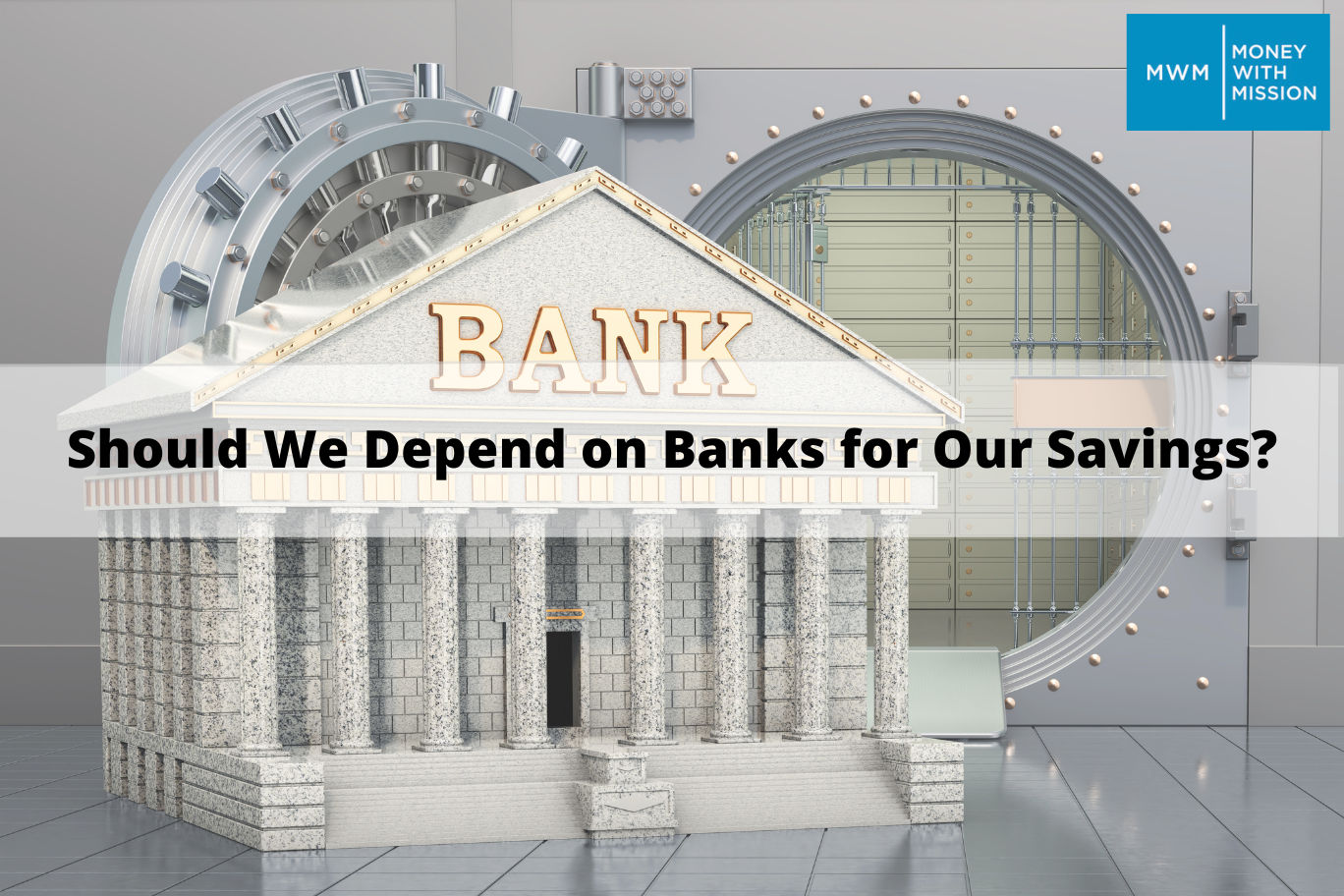
Should We Depend on Banks for Our Savings?

[vc_row][vc_column][vc_column_text]

I have an account at a bank that is at risk of failing.

How do banks fail? Why do banks fail?

First, how do banks make money?

They take deposits from customers and use that money to make loans and investments. They make money from the money that you have sitting there.

For example, you’ve saved $100K for your 6-8 months of emergency expenses. Let’s say you have it in a CD that is earning 5% interest. The bank will lend your $100,000 to someone(s) for 10-15% interest or invest it in something where they will get that amount of interest. AND, they can loan your $100K 9 times! In other words, they can loan or invest $900,000 at 10-15%. They use some of the return to pay your 5% and the rest is theirs. Make sense?

The bank’s risk is that the loan or the investment goes bad and they don’t make their 10-15%. When the bank is getting a lot of big deposits it cannot loan the money fast enough to keep up (remember they at least need to keep their promise to pay your interest).


What do they do?

They invest the money. They can invest faster than they can make loans. Many banks invest in bonds. Sometimes federal bonds. In other words, they loan their money to the government or sometimes another agency. The bank is now getting paid interest on the money they have loaned.

Hang in there. If this is confusing or you find yourself getting sleepy. Here’s a more personal example.

Your sister gives you $1000 to hold. You tell her, because she trusts you with the money you will pay her $100 if she lets you keep it for one year. You do that because you know your brother needs $500.

You loan him $500 (of your sister’s money) and he has to pay you $100 interest in 6 months. He really needs the money so he agrees. Six months go by and your brother performs, he pays you $600. Since you have another 6 months, you loan another $500 to your brother’s friend at the same terms. He performs and pays you $600. Now you’ve made $200 off of your sister’s money. You return her money +$100 like you promised and you keep $100!

The bank has loaned money (invested in bonds) at a particular interest rate. As you probably know the federal reserve has been increasing interest rates. Here’s a tricky part, when interest rates go up the value of the bond goes down.

Most bonds pay a fixed interest rate that becomes more attractive if interest rates fall, driving up demand and the price of the bond.

Conversely, if interest rates rise, investors will no longer prefer the lower fixed interest rate paid by a bond, resulting in a decline in its price.

There are less people who want to buy your bonds so you have to sell them cheaper to get rid of them.

Oh, no. But I owe more than I can sell these bonds for! And I have loaned or invested more money than I have and now these people want their money back, and I don’t have it.

And that’s how they fail.

image

I realize there is a bit more to it than that, but that’s the gist of the situation.

And you thought your money was safe sitting in that bank?!

Owning cash flowing assets are ALWAYS a safer bet. If you get it and are ready to get your money working for you in a safer way, let’s talk. If you don’t get it, let’s talk it out!

Book A Call

[/vc_column_text][/vc_column][/vc_row]
Share:

Facebook
Twitter
Pinterest
LinkedIn

Leave a Reply

Your email address will not be published. Required fields are marked *

Related Posts

ICYMI: Money Tales: Money’s Everywhere with Dr. Felecia Froe

In this ICYMI conversation, Dr. Felecia Froe sits down with Sandi Bragar and Cammie Doder on the Money Tales podcast to trace the money narrative that shaped her from childhood all the way to founding Money With Mission. She opens up about watching her mother stay in a domestic violence relationship for financial reasons, the credit card mistakes she made in medical school, and how she used the CASHFLOW 101 game to teach her own daughters about money years before most parents even start the conversation. Felecia also walks through the deal that changed everything: a patient named Jamie who challenged her to buy her first real estate property and removed all the risk in doing so.

Foundations #10: You’re Not Bad with Money

You’re not bad with money. In this Foundations episode, Dr. Felecia Froe speaks directly to every woman carrying the belief that she’s somehow failed at money, whether she’s avoided her finances for years, watched a high income never translate into confidence, or is still making sense of a setback that shook her trust in herself. Felecia reframes the whole story: what looks like carelessness is actually overwhelm, what looks like incapability is actually a lack of preparation, and what looks like personal failure is actually a systemic failure.

ICYMI: How to Invest When You’re Scared (Because Everyone Is) with Dr. Felecia Froe

Felecia Froe became a urologic surgeon after succeeding in medical school and urology residency. Somehow she knew this wasn’t the last thing she would ever do. Her mind as rewired about the idea of money after reading Rich Dad Poor Dad by Robert Kyosaki. In this ICYMI conversation with Mary Katherine Johnson of Planet Wealth, Felecia traces her path buying 18 properties in two years, losing nearly everything in the 2008 crash, and rebuilding into a social impact investor who’s now running sober living homes and fighting food deserts. She gets honest about the fear that doesn’t fully go away, even after decades of deals, the mindset shift from working for money to making money work for you, and why she believes no woman should ever feel financially stuck in a job or relationship.