

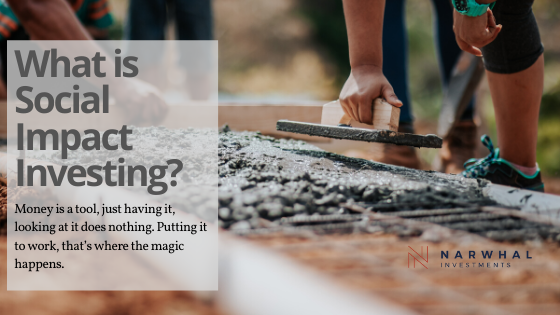
[vc_row][vc_column][vc_column_text]Social impact investing is a way to give money a purpose. It can help create a sense of power for those using it to improve the world around them. Taking care of our elderly is particularly important to me. I have friends who have used their money, with money from investors, to start an assisted living home for people with dementia. They are providing peace of mind to families with members that cannot stay alone safely, they are providing a safe, secure community for the memory-challenged. Getting up and working every day to make money that is used to provide peace of mind and community is truly giving money a purpose and having an impact.
 Doesn’t everything I invest in have a positive social impact?
Multi-family investments provide housing for people, that’s social impact, right? Commercial buildings that I invest in give a business a place to do business, that’s positive, right?
In the strictest sense, to meet the basic definition of impact investment, the impact of the project must be measured. For example, the project promises to create 200 jobs. There should be a time frame in which the objective is met and it should be measured. Did the fund meet the goal? If not, why not. There may be very good reasons. The point is that the impact is definable and measurable.
Projects and funds may be impact motivated, impact committed or impact certified. The projects mentioned above are likely impact motivated. The folks who put together the deal want to make a difference. Their focus may look like this; 1. Financial return, 2. Desire for positive impact, 3. Consistency with the values of the company.
An impact committed project goes a bit further, 1. Demonstration of intent to have a social impact, 2. Commitment to measure against a set of targeted metrics, set by the company and 3. Commit to transparency and regular reporting to investors.
To become impact certified the company agrees to 1. Third-party validation, 2. Measurement against a comprehensive set of third party metrics and must meet a minimum score.
Many social impact companies, at this point, have chosen the middle of the road option. For startups, which many of these companies are, it is challenging enough to get the project off the ground with the commitment to having a positive social impact. Adding the layer of third party verification could make it impossible for many of these companies to get started.
There are a lot of companies out there working to make a difference, here is one of my favorites. Find where you want to make an impact and I am sure that there is a company out there that you can help.
EcoAlliance Group, a company I am associated with, is out to solve the problem of food access and distribution. We are beginning our work in Tulsa, Oklahoma by building commercial hydroponic greenhouses and operating grocery stores in food deserts. We are providing jobs, education, and healthy organic food to the city and the region through our relationships with national grocery store chains and food wholesalers. Visit our website at www.ecoallianceinvestments.com.
Improving access to healthy, locally sourced food, increasing the living wage while providing STEM education are impacts that are important to me. Does this speak to you? Join us![/vc_column_text][vc_btn title=”Find Out More!” style=”custom” custom_background=”#b13629″ custom_text=”#ffffff” css=”.vc_custom_1591206632458{padding-left: 350px !important;}”][/vc_column][/vc_row]